 The debate of whether students are or are not ‘customers’ of their University is a well worn one, so it was of great interest to see this report published today via Universities UK which put the matter to rest once and for all, and the result was…
 mark.drechsler
Changes in the Australian Higher Ed LMS landscape – a wave, or just a ripple?
 This week, the University of Sydney announced that it was migrating from Blackboard Learn to Canvas, joining RMIT, UC and the University of Adelaide who have also announced similar moves in the last twelve months. No doubt this is sending one or two quivers through the camps of the ‘Big Three’ LMS platforms which until recently made up the entirety of the incumbent LMS landscape in Australian Higher Ed – Blackboard Learn (21 Universities), Moodle (15) and Brightspace by D2L (3)*.
But are we about to see a wave of change in the LMS landscape across Australia, or will it be more like a ripple?
University marketing – a diversity of sorts
 It was Seth Godin who described marketing as a contest for people’s attention, and recently I’ve been pondering the different ways which Universities are attempting to grab the attention of potential students, particularly as the looming Federal budget looks almost certain to increase cost for students. The more students are required to pay for Higher Education, the more seriously many of them will take the choice of course and provider, and for that matter consider whether a Degree is even worth it (as I talked about in my last blog post). This pressure will no doubt have University marketing departments hot-to-trot on making sure that their University’s brand is being represented in the most enticing way possible, but across the 43 accredited Universities in Australia offering a highly regulated (and in many cases some would argue largely indistinguishable) product, how are Universities attempting to differentiate?
MOOCs won’t disrupt Higher Education, employers will
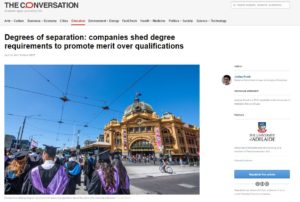 Last week I wrote a post on ‘students as customers’ in the context of a more corporatised, commoditised Higher Education market. It was interesting then to see another post today discussing the emerging trend of employers dropping requirements for degrees as part of their recruitment criteria, instead selecting candidates
based on merit, rather than credentials, often by assessing candidates with psychometric testing or other performance based tests
This caught my attention for two* reasons. Firstly, it returned my thoughts to the student as a customer, and the likely increase in their willingness to leave the Higher Education system (or not engage in it at all) if it is not meeting their expectations – in this case employability. Secondly, it made me reflect on the role of MOOCs, not as a replacement for a degree, but as a potential perceived indicator of merit in a landscape where a degree is no longer a necessity.
 I started receiving notifications from